
From ‘Rosie the Riveter’ to ‘Helen the Housewife’
*
From ‘Rosie the Riveter’ to ‘Helen the Housewife’ *
Beginning in the 1600, advertising was once a simple system of proclamation and announcement: the conjointment of words was not called copy, and imagery would solely illustrate in order to distinguish – it didn’t appeal to others’ emotions, nor offered audiences entertainment and let alone was described as ‘manipulative’ as we so-hear today (O’Barr, 2010).
The basis of such practice has always been to ‘draw attention to something’, to publicly announce or inform. However, as society naturally evolved and capitalists’ systems took over, the practices surrounding this action became evasive and mischievous as a result of being unregulated (ibid) – and now we suffer the consequences.
Dyer (1982) argues that advertising is comparable to myths in primitive prehistoric societies: it provides people with simple narratives and stories that can be interpreted to shape values and ideals; when combined with personal experiences and thoughts, it helps those to make sense of the world they live in.
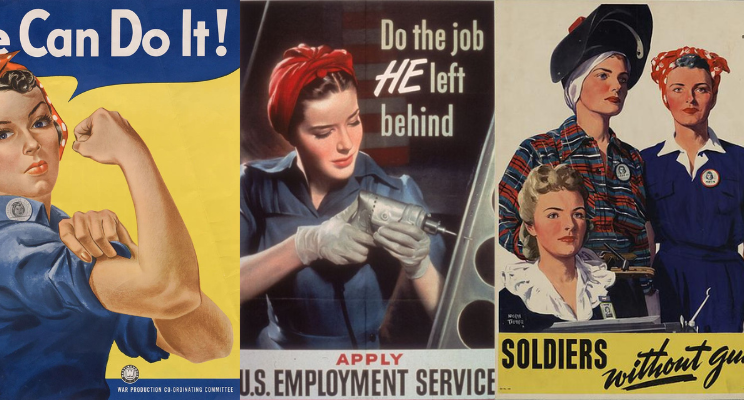
Advertising practices during World War II are perfect evidence to illustrate this point – Fast-forwarding to the 1940s, unemployment rates in the United States dropped from 13% in 1937 to 1.3% in 1949 – when most men left for war, there was a significant lack of ‘manpower’ in industrial jobs that would later be occupied by women (Charles Lewis and John Neville, 1995). The government held authority over the ‘madmen’, and advertising shifted to patriotic/institutional propaganda serving the purpose of comforting the population that had just gone through the Great Depression, it brought people a sense of hope with promises of a new and better life post-war.
However, the economy showed otherwise as men played a great part in the working force and its absence became detrimental to the living of those who stayed, at first, advertising warned the population to "Use it Up – Wear it Out – Make it Do" in effort to reduce the needs of consumer goods as production slowed down (Covert, 1972). Therefore, a new marketing strategy was set to solve everyone’s problems: ‘Womanpower Campaigns’ were designed to influence American Women to contribute to the war effort by encouraging them to overlook ‘outdated’ stereotypes towards working outside their home (Charles Lewis and John Neville, 1995).
Famously embodied by ‘Rosie the Riveter - We Can Do It’ and other heroic imageries, persuasion techniques were shown successful as the economy bettered, women became the new face of consumerism as a result of their financial independence. However, it was unknown to women that their partaking in the workforce was being seen as a threat and their labour was solely temporary since positions were meant for the absent men (Covert, 1972). There was a certain resistance when it came to employing married women, as society grew worried about who was raising and taking care of their families, advertising messages also encompassed their responsibilities of motherhood comparing their homes to the ‘second front’ in the war (ibid).
Messages showed to contradict themselves as, on one hand, empowered women to join the workforce alongside a feminist tone, and on the other hand, expected women to comply with prevailing gender ideologies enforcing their role as housewives (Covert, 1972). Advertising used an emotional and rather manipulative approach to emphasise the essentiality of motherhood, with advertisements dramatizing the sorrow of children who miss their mothers while they are at work (Honey, 1984). Once women saw hope in an evolution of patriarchal systems, advertisements diverged from ‘Rosie the Riveter’ to ‘Helen the Housewife’ (Pfaff, 2011).
Betty Friedan’s book ‘The Feminine Mystique’ took part in explaining how World War II rewrote the role of women in society in the Western world and erased the efforts and gains their suffragist ancestors fought for: when women started gaining access to higher education and entering the labour force, they were expected to go back home seek fulfilment as wives and mothers. An era corrupted by Freudian ideals implying that women could only pursue glory in their own femininity (Friedan, 1963) and reinforced by advertisements that projected females as submissive, passive, vulnerable and dependent (Maclaran, 2015).
While mass media is criticized for its long response to changes in a larger society (Covert, 1972), history proves otherwise. Advertising served as a catalyst for lagging a natural societal evolution, but on the other hand, its effects on the economy shaped the world we live in today. Women became the new face of consumerism; advertising knew the right medium to target women and depended on their spending power. The industry was mostly occupied by men, and therefore, was a reflection of their narratives – It would ‘bring paranoia to solve paranoia’ – As an example, it would reinforce the importance of femininity and the lack-off to sell cosmetic products, it would emphasize how domestic appliances could ease their housewife duties, it would sexualize women with imageries of unrealistic bodies to comply to the male gaze.
Many elements of this article seem familiar when compared to modern society – that capitalism exploits others under the excuse of economic growth, that advertising can be argued as manipulation or a useful system of mass influencing and that women are the victim of an unjust and ongoing patriarchal system. Although, currently, there has been fortunate growth in ‘femvertising’ (a feminist marketing strategy that empowers and celebrates women's freedom) (Varghese and Kumar, 2020) it makes us question how legitimate those motivations are and if its underlying purposes are as illegitimate as advertising during the WWII.
Adkins Covert, Tawnya J. Manipulating Images: World War II Mobilization of Women through Magazine Advertising. Lexington Books, 1972.
Dyer, Gillian. ‘Advertising as Communication (Studies in Culture and Communication)’. In Advertising as Communication, 2. Routledge, 1982.
Friedan, Betty. The Feminine Mystique. Penguin Classics, 1963.
Honey, Maureen. Creating Rosie the Riveter: Class, Gender, and Propaganda During World War II. University of Massachusetts Press, 1984.
Lewis, Charles, and John Neville. ‘Images of Rosie – Content Analysis of Women Workers in American Magazine Advertising, 1940 - 1943’. J&MC Quarterly 72, no. 1 (1995): 217. https://doi.org/10.1177/107769909507200118.
Maclaran, Pauline. ‘Feminism’s Fourth Wave: A Research Agenda for Marketing and Consumer Research’. Journal of Marketing Management 31 (2015). http://dx.doi.org/10.1080/0267257X.2015.1076497.
O’Barr, William M. ‘A Brief History of Advertising in America’. Advertising Educational Foundation 11, no. 1 (2010). https://muse.jhu.edu/article/377516.
Pfaff, Christina. ‘Rosie the Riveter vs. Helen the Homemaker: Advertising and the Role of Women in America after World War II’. Honors Theses, 2011. https://scholarship.richmond.edu/honors-theses/1265.
Varghese, Neema, and Navin Kumar. ‘Femvertising as a Media Strategy to Increase Self-Esteem of Adolescents: An Experiment in India’. Children and Youth Services Review 113, 2020. https://doi.org/10.1002/mar.21023.